


When Should I Be Concerned About a Groin Lump?
A groin lump that comes and goes may be caused by an inguinal hernia. However, certain symptoms associated with an inguinal hernia require urgent medical attention.
Seek urgent medical attention if your child has:
- A groin or scrotal lump that becomes suddenly painful
- A lump that becomes firm, swollen, or red
- Swelling that does not go away
- Persistent crying or significant discomfort
- Vomiting
- Abdominal distension
- A child who appears very unwell
These symptoms may indicate that the hernia has become trapped (incarcerated) or that its blood supply has been compromised (strangulated). Prompt medical assessment is important if any of these symptoms occur.
What Is an Inguinal Hernia in Children?
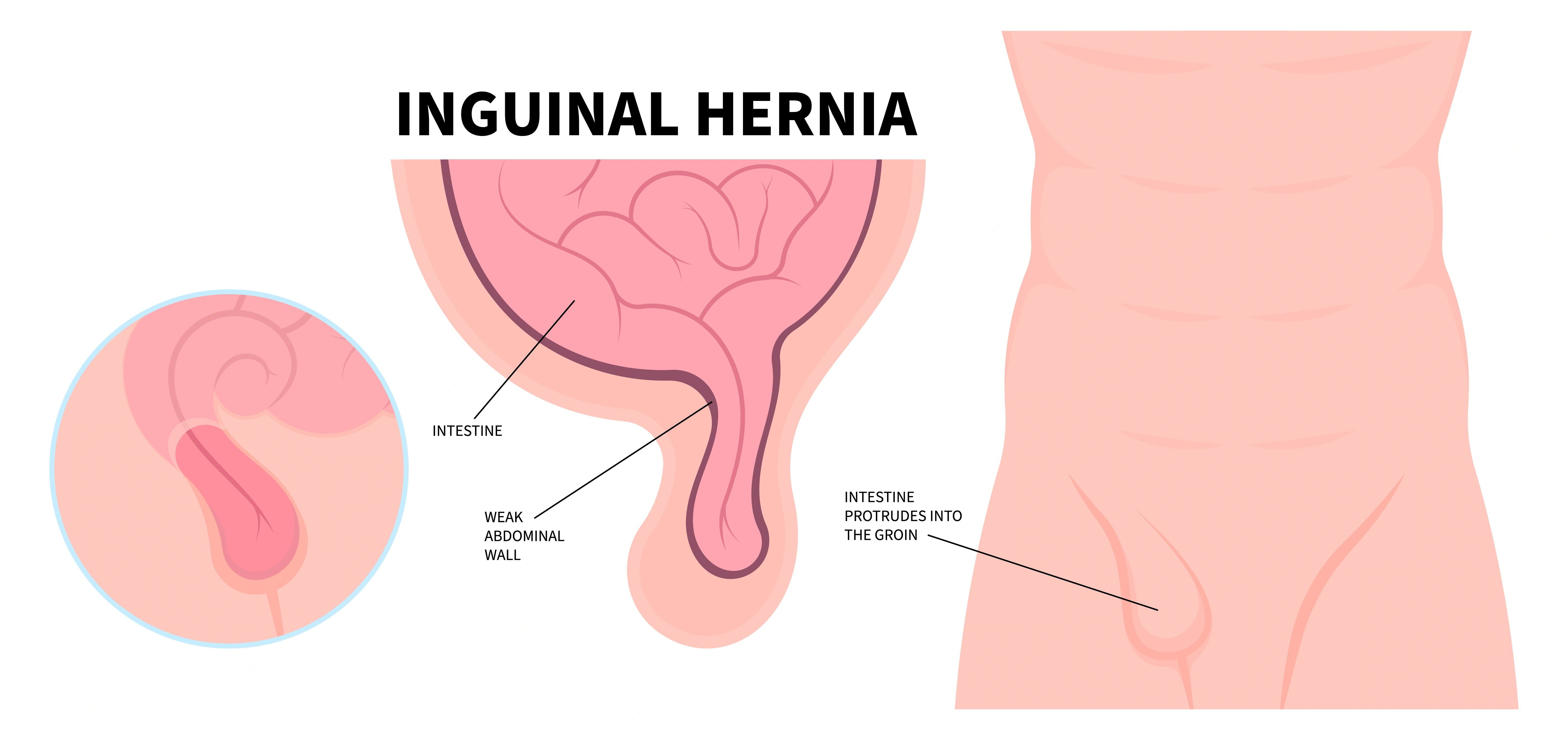
A hernia occurs when tissue from inside the abdomen pushes through an opening or weak area in the abdominal wall.
In children, the most common type is an indirect inguinal hernia, which develops in the groin area.
You may notice:
- A soft lump or swelling in the groin
- Swelling that becomes more noticeable when your child cries, coughs, or strains
- A lump that becomes smaller or disappears when your child relaxes
- Swelling that extends into the scrotum in boys
- Swelling around the groin or labia in girls
Most children with an inguinal hernia may seem to be well. However, the hernia does not usually resolve on its own and should be assessed for appropriate treatment, as it carries a risk of complications such as strangulation, in which the herniated contents become trapped, and their blood supply is compromised.
Does a Child with Hernia Need Surgery?
Yes, surgery is recommended to resolve the condition and to prevent complications. Surgery is performed to close the opening through which abdominal contents pass.
The timing and type of surgery depend on factors such as your child’s:
- Age
- Symptoms
- General health
- Hernia’s anatomy
Before surgery, Dr Cheong will explain what the procedure involves, the anaesthesia your child will receive, and what to expect during recovery.
What Is a Hydrocele in Boys?
A hydrocele is a collection of fluid around the testicle that causes swelling in the scrotum.
Hydroceles are relatively common in newborn boys.
For babies and children with hydrocele, you may notice:
- Smooth, painless swelling around one or both sides of the scrotum.
- Swelling that changes slightly in size during the day but doesn’t completely disappear.
Unlike a hernia, a hydrocele contains fluid rather than abdominal contents, but occasionally, both conditions can co-exist.
A hydrocele and a hernia can sometimes present with similar symptoms, and it is important to confirm that the hydrocele is not caused by a problem with the testis.
Treatment for Hydrocele
Many hydroceles in babies improve naturally during the first year of life as the connection between the abdomen and scrotum closes.
Surgery for hydrocele is recommended for persistent or symptomatic cases, particularly when the hydrocele is large, heavy, or tense, as well as those associated with a hernia.
What Are Undescended Testicles?
Before birth, a baby boy’s testicles normally descend into the scrotum.
Sometimes, one or both testicles fail to descend into the scrotum as expected. This condition is known as undescended testicle(s).
You may notice:
- An asymmetrical appearance of the scrotum.
- One or both testicles are not palpable in the scrotum.
However, undescended testicles may not always be obvious to parents and are often detected during a routine physical examination.
Before birth, a baby boy’s testicles normally move down into the scrotum.
Sometimes, one or both testicles do not move into the scrotum as expected. This condition is known as undescended testicle(s).
You may notice:
- Asymmetrical looking scrotum
- You cannot feel one or both testicles in the scrotum
However, an undescended testicle may not always be obvious to parents and is often identified during a physical examination.
Treatment for Undescended testicles.
Testicles that have not descended into the scrotum by 6 months of age should be evaluated by a paediatric surgeon.
Surgery may be recommended to bring the testicle into the scrotum, helping to reduce the risk of complications, including future fertility problems and an increased risk of testicular cancer.
What Is Recovery Like After Surgery for Hernia, Hydrocele and Undescended Testicle?
These procedures can usually be performed as day surgery, allowing your child to return home on the same day, provided recovery is uncomplicated.
Most children recover well and can return to their usual activities within a few days to a couple of weeks, depending on the type of surgery and their individual healing process.
Your paediatric surgeon will provide specific instructions on wound care, pain relief and when your child can resume normal activities. Follow-up appointments may also be arranged to monitor healing and ensure a good outcome.

Dr Cheong Yee Ling
Nobel Paediatric Surgery Centre, Mount Elizabeth Novena & Gleneagles, Singapore
MBBS (Malaya), MRCSI (Ireland), FAMS (Paediatric Surgery)
Dr Cheong provides assessment and management for both elective and emergency paediatric surgical conditions. Her areas of practice include abdominal, thoracic, urological, and inguinoscrotal conditions in children.
She has contributed to publications in local and international medical journals and has held teaching appointments at the Yong Loo Lin School of Medicine, National University of Singapore (NUS), and Duke-NUS Medical School.
Insurance and TPA panels: Adept, AIA, Alliance, Bupa, Fullerton, Geoblue, Great Eastern Life, HSBC Life, IHP, Income, iXchange, MHC, Prudential, SAH, Singlife
Clinic Practice Place
Nobel Paediatric Surgery Centre
(Gleneagles Hospital)
6A Napier Road, Annexe Block Unit #02-37
Singapore 258500
Operating Hours
Mon, Wed, Fri: 08:30 – 13:00 | 14:00 – 17:30
Tues, Thurs, Sun & PH: Closed
Nobel Paediatric Surgery Centre
(Mount Elizabeth Novena)
38 Irrawaddy Road #07-31
Singapore 329563
Operating Hours
Tues, Thurs: 08:30 – 13:00 | 14:00 – 17:30
Sat: 08:30 – 12:30
Mon, Wed, Fri, Sun & PH: Closed
Frequently Asked Questions (FAQ)
An inguinal hernia may appear as a soft lump or swelling around the groin or scrotum. It may become more noticeable when your child cries, coughs, strains or is active, and may become smaller when they relax.
A hernia may not cause symptoms initially, but the tissue inside it can sometimes become trapped. Seek urgent medical attention if the swelling becomes painful, firm or swollen, does not go away, or occurs together with vomiting or visible signs of being unwell.
An inguinal hernia in a child generally does not close naturally. Once diagnosed, a paediatric surgeon can assess your child and advise on treatment.
A hernia occurs when abdominal tissue passes through an opening into the groin or scrotum.
A hydrocele contains fluid around the testicle. They may sometimes look similar, so a physical examination can help distinguish between them.
Some testicles descend naturally during early infancy. If the testicle remains undescended, your child should be assessed to determine whether treatment is required.
Yes. Hernias and hydroceles can both be related to an opening between the abdomen and groin that has not completely closed, although they are different conditions.
A paediatric surgeon can assess these conditions in babies, children and adolescents and advise whether monitoring, further investigation or surgery may be appropriate.