

Bell’s Palsy is a condition that causes sudden weakness or paralysis on one side of the face. It happens when the facial nerve becomes swollen or inflamed. This nerve controls facial movements such as smiling, blinking, and raising eyebrows. It also plays a part in taste, tear production, and sound sensitivity.
Symptoms usually develop acutely or over several hours and are typically noticed within two to three days. Most people gradually regain facial movement, although recovery time varies.
Because sudden facial weakness can also be a sign of a stroke, it is important to seek medical attention immediately rather than trying to diagnose the cause yourself.
What Are the Symptoms of Bell’s Palsy?
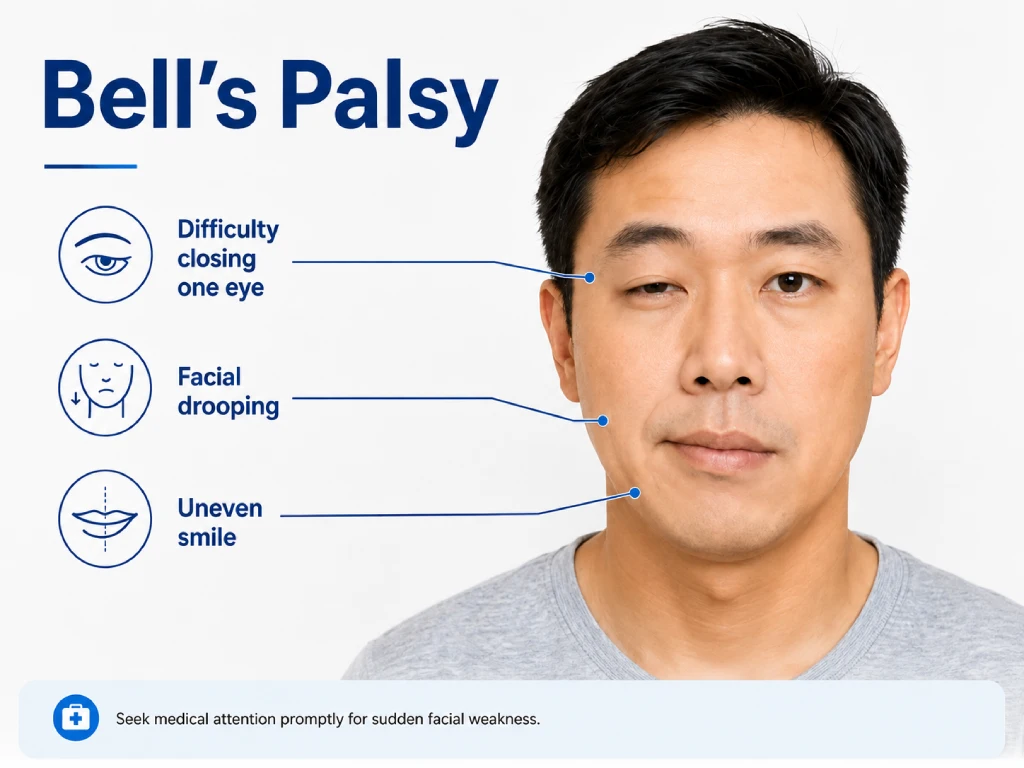
Bell's Palsy usually affects the forehead, eye and mouth on one side of the face.
Symptoms may include:
- Drooping on one side of the face
- Difficulty smiling or making facial expressions
- An eye that cannot close fully
- A dry or watery eye
- Changes in taste
- A heavy or numb feeling in the face
- Difficulty speaking clearly
- Ear symptoms or hearing disturbances
The face may feel numb, but the ability to feel touch is usually still present. Bell's Palsy rarely affects both sides of the face at the same time.
What Causes Bell’s Palsy?
The exact cause is often unknown. Bell's Palsy develops when the facial nerve becomes inflamed and swollen. This affects the signals sent from the nerve to the muscles on one side of the face.
Viral infections may trigger this inflammation in some people. Viruses associated with Bell’s Palsy include those that cause:
- Cold sores
- Chickenpox and shingles
- Glandular fever
- Respiratory infections
Having one of these infections does not mean that you will develop Bell’s Palsy.
Bell’s Palsy is not contagious, although an infection linked to it may be passed between people.
How Is Bell’s Palsy Diagnosed?
There is no single test used to confirm Bell’s Palsy. This is usually a clinical diagnosis of exclusion.
The doctor will ask when the weakness started and whether you have other symptoms. You may also be asked to:
- Raise your eyebrows
- Close your eyes
- Smile or show your teeth
- Puff out your cheeks
The doctor may do a general head and neck examination, including your ears, eyes, and facial movements, to look for other possible causes.
How Is Bell’s Palsy Treated?
Treatment aims to reduce swelling around the facial nerve, protect the eye and support recovery.
Corticosteroids
A doctor may prescribe corticosteroids to reduce inflammation. Treatment is usually most effective when started within 72 hours of the symptoms appearing.
Antiviral Medicine
Antiviral medicine may sometimes be given together with corticosteroids, especially when symptoms are severe, or a viral infection is suspected.
Eye Care
If the eyelid cannot close fully, the eye may become dry or irritated. Treatment may include:
- Lubricating eye drops
- Eye ointment at night
- Protecting or gently taping the eye during sleep
- Wearing sunglasses outdoors
Seek medical advice if the eye becomes painful, red, or sensitive to light, or if your vision changes.
Facial Rehabilitation
If facial weakness, tightness or uneven movement continues, guided facial exercises or rehabilitation may help.
Eating and Drinking with Bell’s Palsy
Weakness around the mouth may make eating and drinking more difficult.
It may help to:
- Take smaller bites
- Eat slowly
- Choose softer foods when needed
- Chew on the stronger side
- Check that food has not collected inside the affected cheek
- Take care with hot food and drinks
- Clean the mouth after meals
Speak to a doctor if you are unable to drink enough, regularly choke, or have difficulty swallowing.
Can Bell’s Palsy be Prevented?
There is no known way to prevent Bell’s Palsy because its exact cause is often unclear. Managing conditions such as diabetes and high blood pressure supports overall health but cannot guarantee that Bell’s Palsy will not occur.
When Should You See a Doctor?
Seek medical attention immediately when facial weakness or paralysis first appears. A healthcare professional needs to rule out a stroke and other possible causes.
Arrange further review if:
- Your eyelid cannot close fully
- The eye becomes painful, red or irritated
- Your vision changes
- Weakness continues to worsen
- You develop hearing loss, severe dizziness or blisters in the ear
- Symptoms affect both sides of the face
- You have difficulty eating, drinking or swallowing
- Facial movement does not begin to improve
- Symptoms return after previously resolving
Frequently Asked Questions (FAQ)
No. Bell’s Palsy affects the facial nerve, while a stroke affects blood flow in the brain. However, both can cause sudden facial weakness, so immediate medical assessment is important.
Bell's Palsy normally affects facial movements on one side. Weakness in an arm or leg, problems with speech, severe dizziness or loss of balance may suggest another condition and require emergency assessment.
Weakness in the lips and cheeks can make some words harder to pronounce clearly. Speech usually improves as facial movement returns.
It can return, but recurrence is uncommon. Repeated facial paralysis should be assessed to exclude other causes.
If you develop sudden facial weakness or drooping, seek medical attention promptly to rule out a stroke or another serious condition.
If your facial weakness does not improve despite treatment, and a reasonable watchful waiting period has been given, it is important to see an ENT specialist to rule out other causes of facial weakness.
There are treatment options available for patients with poor facial nerve function recovery from Bell’s palsy. This may include facial rehabilitation, botulinum toxin injections and facial surgeries. The aim is to improve facial symmetry and manage complications of chronic facial weakness.
You may visit a GP, an emergency department, or an ENT specialist for an initial assessment.
At Nobel ENT Centre, Dr Fung Chak Yuen, Consultant ENT Surgeon, manages a wide range of Ear, Nose and Throat conditions, including facial nerve palsy such as Bell's palsy. He provides a comprehensive assessment to confirm the diagnosis, rule out other possible causes of facial weakness, and recommend a personalised treatment plan to support recovery and ongoing care.