

Singapore has one of the highest rates of diabetes among developed nations. According to the Ministry of Health, approximately one in three Singaporeans will develop diabetes in their lifetime. Many are already living with it and managing their condition reasonably well on the surface: blood glucose is being monitored, medication is being taken, and lifestyle adjustments have been made.
And yet, even among people who are actively managing their diabetes, complications can develop quietly in the background. They tend not to announce themselves with dramatic symptoms. They progress gradually, through changes in the eyes, the feet, and the body's metabolic balance, often for months or years before they become noticeable. By the time they do, some of the damage can be difficult to reverse.
This article looks at three areas of the body that diabetes affects in ways that are frequently underestimated: vision, foot health, and metabolic control. Understanding what is happening in each area, and why coordinated specialist care matters, is the foundation of genuinely managing diabetes rather than simply reacting to it.
1. Your Eyes: The Silent Progression of Diabetic Retinopathy
The eye is one of the first organs to be affected by sustained high blood glucose levels, and it is among the most significant. Diabetic retinopathy is a condition in which the small blood vessels of the retina, the light-sensitive layer at the back of the eye, are damaged by the effects of chronically elevated blood sugar.
What makes this particularly difficult for patients to detect on their own is that early-stage retinopathy produces no symptoms at all. Vision remains clear. There is no pain. The changes happening inside the eye are entirely invisible without specialist examination. By the time blurring, floaters, or visual disturbance become noticeable, the condition has typically progressed to a more advanced stage.
How Diabetic Retinopathy Develops
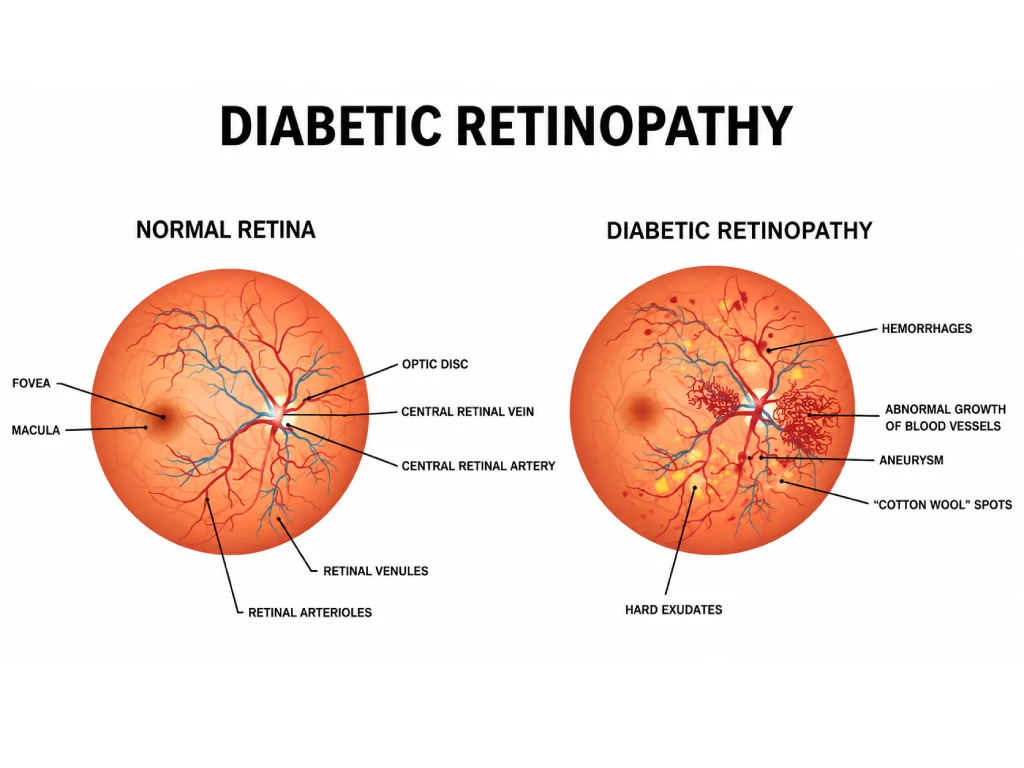
Persistently high blood glucose damages the walls of the tiny capillaries supplying the retina. These vessels can leak fluid, swell, or, in more advanced cases, close off entirely. The retina responds to reduced blood supply by growing new, fragile blood vessels in a process called neovascularisation. These new vessels are structurally weak and prone to bleeding, which is when vision loss begins to occur.
The condition is staged from non-proliferative (early, where vessels are leaking but new growth has not yet begun) to proliferative (advanced, where abnormal vessel growth is present). Diabetic macular oedema, where fluid accumulates at the central part of the retina responsible for sharp vision, can occur at any stage and is one of the leading causes of significant vision impairment in people with diabetes.
Why Annual Eye Screening Is Not Optional
The reason ophthalmologists emphasise annual dilated eye examinations for all people with diabetes is straightforward: treatment is far more effective when retinopathy is identified early. Laser therapy, anti-VEGF injections, and careful blood sugar management at the non-proliferative stage can slow or halt progression significantly. At the proliferative stage, options still exist, but outcomes are less predictable and more invasive. An annual review with a specialist ophthalmologist is the single most reliable way to catch retinopathy before it affects your vision.
Other Eye Conditions Linked to Diabetes
Retinopathy is the most discussed, but diabetes increases the risk of several other ocular conditions. Cataracts tend to develop earlier and progress more rapidly in people with diabetes, likely due to osmotic changes in the lens. Glaucoma, which involves damage to the optic nerve, is also more prevalent among diabetic patients. All of these are detectable through routine specialist eye examination, which is another reason why regular review matters beyond retinopathy screening alone.
2. Your Feet: Why Diabetic Foot Complications Escalate Faster Than Expected
The feet are, in many ways, the furthest point from the heart and from the organs most people think about when they think about diabetes. They are also among the most vulnerable, for reasons that are directly related to two of diabetes's most common complications: peripheral neuropathy and peripheral arterial disease.
Peripheral Neuropathy: When the Warning System Breaks Down
Peripheral neuropathy is nerve damage affecting the extremities, most commonly the feet and lower legs. It develops over time as a result of sustained elevated blood glucose affecting the nerves' ability to function and regenerate. The presentation varies: some people experience tingling, burning, or sharp shooting pain. Others notice a progressive numbing, a reduction in the ability to feel temperature, pressure, or pain.
It is the numbing presentation that carries the greatest risk of serious harm. Pain is the body's signal that something is wrong. When that signal is absent or muted, injuries that would normally prompt immediate attention go unnoticed. A blister from ill-fitting shoes, a small cut from a nail edge, a pebble inside a sock, all of these become potential entry points for infection when the person cannot feel them.
Poor Circulation: Why Small Wounds Become Big Problems
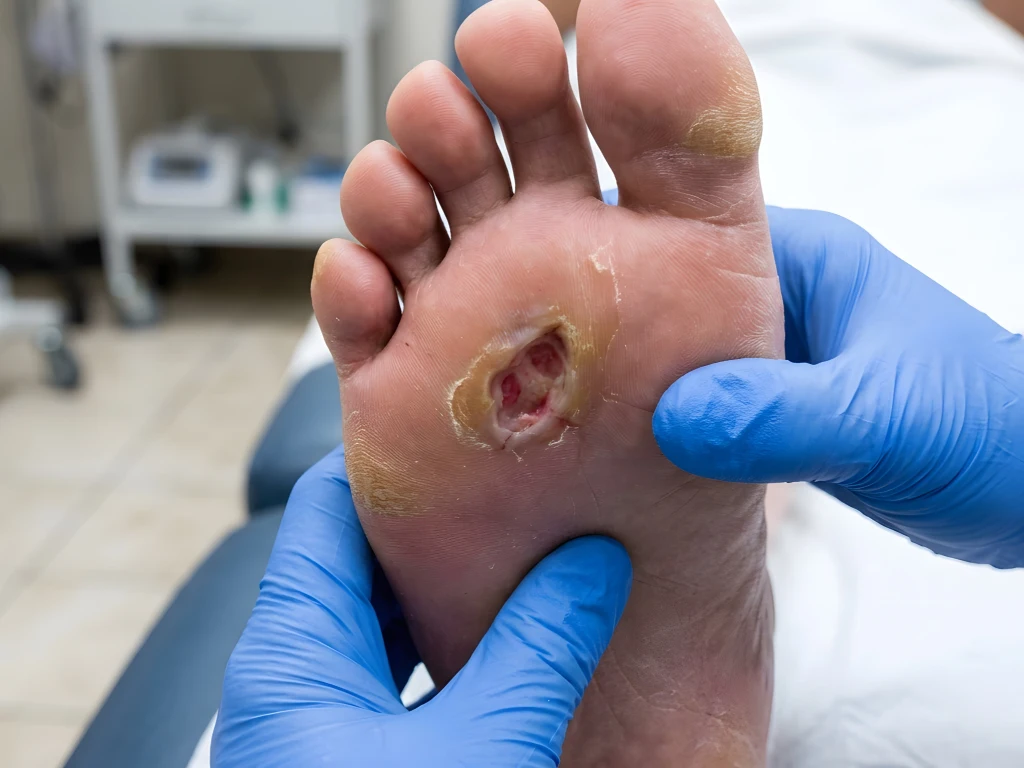
Peripheral arterial disease, the narrowing and hardening of the arteries supplying the lower limbs, is significantly more prevalent in people with diabetes. Reduced blood flow means that the immune response to infection is compromised and wound healing is slower. A wound that would take a week to heal in a non-diabetic person might take months in someone with poorly controlled diabetes and significant arterial disease. Left unaddressed, diabetic foot ulcers can progress rapidly to deep tissue infection.
The Cascade That Can Follow a Minor Wound
This combination of reduced sensation and reduced circulation creates a dangerous dynamic. A small wound or skin breakdown that goes unnoticed, because of neuropathy, is simultaneously harder for the body to resolve, because of poor circulation. Bacteria that enter through the broken skin encounter a local environment that is less able to contain them. The infection spreads into deeper tissue, potentially reaching bone.
Diabetic foot complications, including foot ulcers and the more severe consequences that can follow, are one of the leading causes of non-traumatic lower limb amputation in Singapore. This is not an outcome that happens suddenly. It is the end result of a progression that begins with small, manageable problems that were not identified and addressed in time.
What Regular Podiatry Review Changes
Regular podiatric foot assessment for people with diabetes involves far more than nail trimming. A structured diabetic foot screening checks circulation (using Doppler assessment of blood flow), sensation (using monofilament and vibration testing to map neuropathy), skin integrity, nail health, foot structure, and footwear. This gives a complete picture of the foot's vulnerability at any given point in time, and identifies early warning signs before they escalate.
People with diabetes are advised to have a dedicated foot health review with a podiatrist at least once a year, or more frequently if neuropathy, ulceration, or circulation concerns are already present.
People with diabetes should inspect their feet every single day: the tops, soles, heels, and between the toes. Any cut, blister, redness, swelling, or area of unusual warmth warrants prompt attention from a healthcare professional, regardless of whether it is painful.
Nails, Skin, and Footwear: Details That Matter More in Diabetes
Nail and skin conditions that are minor inconveniences for most people carry significantly higher risk for someone with diabetes. An ingrown toenail that becomes infected, a corn or callus that breaks down, or a fungal nail infection that distorts the nail plate and increases pressure on surrounding skin can all become entry points for more serious infection in a person with compromised circulation and reduced sensation. These are not cosmetic concerns. They are clinical ones.
Footwear is equally important. Shoes that are too tight, too loose, or have interior seams that create friction against numb skin are a leading cause of pressure wounds and blisters in people with diabetic neuropathy. A podiatrist can advise on appropriate footwear, and in cases where foot deformity or abnormal pressure distribution is present, custom orthotics may be warranted.
3. Blood Sugar and Metabolic Control: The Foundation That Everything Else Depends On
Managing blood glucose is the starting point, but it is not the whole picture. What diabetes does to the body over time depends not just on whether glucose levels are being controlled, but on how consistently they are being controlled, and on how the body's broader metabolic health is being managed alongside it.
HbA1c: The Measure That Matters Most
HbA1c is a blood test that reflects average blood glucose levels over the preceding two to three months. It is a meaningful indicator of diabetes management than a single glucose reading, because it captures the pattern of control rather than a single moment in time. Most clinical guidelines recommend a target HbA1c of below 7% for most adults with diabetes, though individual targets are set in discussion with the managing specialist based on the patient's age, other health conditions, and risk of hypoglycaemia (low blood sugar).
Every percentage point reduction in HbA1c carries significant benefit for complication risk. Research has shown that a sustained 1% reduction in HbA1c is associated with a 21% reduction in the risk of any diabetes-related complication, and a 37% reduction in the risk of microvascular complications specifically, which include both diabetic retinopathy and diabetic peripheral neuropathy. This is why consistent metabolic control is not just about how you feel today. It is about what your eyes, feet, and kidneys can look like in ten years.
The Role of the Endocrinologist
General practitioners play a vital role in the initial diagnosis and ongoing management of Type 2 diabetes. However, when blood glucose control is difficult to achieve with standard oral medication, when insulin therapy is required, when there are complicating factors such as thyroid disease, obesity, or significant metabolic syndrome, or when complications are emerging despite reasonable control, referral to an endocrinologist and diabetologist provides a level of specialist assessment that general practice is not always positioned to offer.
Endocrinologists manage the full complexity of hormonal and metabolic health. In the context of diabetes, this means optimising treatment regimens, managing comorbidities that affect glucose control (including thyroid disorders, which are more common in people with Type 2 diabetes than the general population), and supporting patients through the periods of poor control that occur for many people over the course of managing a chronic condition.
Blood Pressure, Cholesterol and Kidney Function
Diabetes does not usually arrive alone. Hypertension and dyslipidaemia (abnormal cholesterol and lipid levels) are present in the majority of people with Type 2 diabetes, and each independently increases the risk of cardiovascular disease, kidney disease, and the vascular complications that affect both eyes and feet. Managing these alongside blood glucose, rather than treating each in isolation, is the approach that genuinely reduces long-term complication risk.
Kidney function (monitored through eGFR and urine albumin-creatinine ratio) is another parameter that requires regular review. Diabetic nephropathy affects approximately 40% of people with diabetes over their lifetime and, like retinopathy, is largely asymptomatic in its early stages. Routine blood and urine tests ordered by the managing GP or specialist can help to detect early kidney changes before function is significantly compromised.
Why Multidisciplinary Care Matters
The complications of diabetes do not occur in isolation from each other. The same mechanisms that damage retinal blood vessels also damage the small vessels in the feet. The same degree of poor glycaemic control that drives neuropathy also accelerates cataract formation and kidney disease. A patient who is receiving excellent glucose management from their endocrinologist but has never had a dilated eye examination or a formal foot assessment is not fully receiving complete care, through no fault of their own.
The most effective model of diabetes management is one where the endocrinologist, the ophthalmologist, the podiatrist, and the GP are aware of each other's findings and are working from a shared understanding of the patient's overall risk profile. This is what coordinated specialist care within a network such as Healthway Medical is designed to enable.
A Practical Summary: What Every Person with Diabetes Should Have in Place
Regardless of how well-controlled your diabetes currently is, the following form the foundation of complication prevention:
- Annual dilated eye examination with an ophthalmologist to screen for retinopathy, macular changes, cataracts, and glaucoma.
- Annual diabetic foot screening with a podiatrist covering circulation, sensation, skin and nail integrity, and footwear assessment.
- Regular HbA1c measurement (typically every three to six months) with a target set by your managing GP or endocrinologist.
- Blood pressure and lipid monitoring alongside glucose control, given the interconnected cardiovascular risk.
- Kidney function monitoring through annual eGFR and urine albumin testing.
- Daily self-inspection of the feet including between the toes and the soles, with prompt review of any skin break, redness, or swelling.
- Specialist review when control is difficult or when complications are suspected, including referral to an endocrinologist if GP management alone is not achieving adequate control.
Catching Problems Before They Catch You
Diabetes is a condition that rewards consistent, proactive management. The complications it causes are not inevitable outcomes. They are risks that are meaningfully reduced when the eyes, feet, and metabolic profile are being monitored regularly by specialists who understand what to look for before symptoms begin.
If you are living with diabetes and have not had a recent diabetic eye review, a formal foot health assessment, or a specialist metabolic review, we can help you. Nobel Medical's endocrinology and diabetology specialists and ophthalmology team are available for consultations, and Straits Podiatry offers dedicated diabetic foot assessments at clinics across Singapore.

Author: Mr Jackie Tey
Chief Podiatrist at Straits Podiatry
Mr Tey is a podiatrist in Singapore with a clinical focus on lower-limb biomechanics, heel pain, and functional rehabilitation. He works closely with GPs and allied health professionals to support patients with complex and persistent foot-related concerns.