

At a Glance
- Your corporate health insurance may cover an outpatient specialist consultation, so check your benefits before paying yourself.
- Corporate medical benefits, MediShield Life, an Integrated Shield Plan and an IP rider may become relevant if a procedure or hospital treatment is recommended.
- Check whether you need a GP referral or must see a panel specialist before making an appointment.
- MediSave can be used for approved medical expenses within set limits.
- Other policies, such as Personal Accident or Critical Illness Cover, may provide additional support in certain situations.
- Coverage varies by plan, so confirm the details with your insurer or HR team.
Your GP recommends seeing a specialist, or a screening result suggests that further investigation is needed. Before you make that appointment, a pertinent question comes to mind: how much will it cost?
For many adults, uncertainty about how much a specialist visit in Singapore is enough to delay the appointment. It is easy to assume that specialist care costs more and will need you to pay it all out of pocket in cash because your employee benefits only cover GP visits.
But you may already have coverage that can help, sometimes from more than one source.
If you are employed, start by looking at your employee benefits and your corporate health insurance in Singapore. Depending on your plan, it may cover specialist consultations as well as GP visits. Some plans also have co-payment or direct billing arrangements, which can reduce the amount you need to pay out-of-pocket upfront.
Other forms of coverage may become relevant if your specialist recommends a procedure or hospital treatment. This guide explains what to check and when, so you have a clearer idea of what may be covered before you book.
Understanding Your Coverage Before a Specialist Appointment
Different ways of managing specialist costs become relevant at different stages of care.
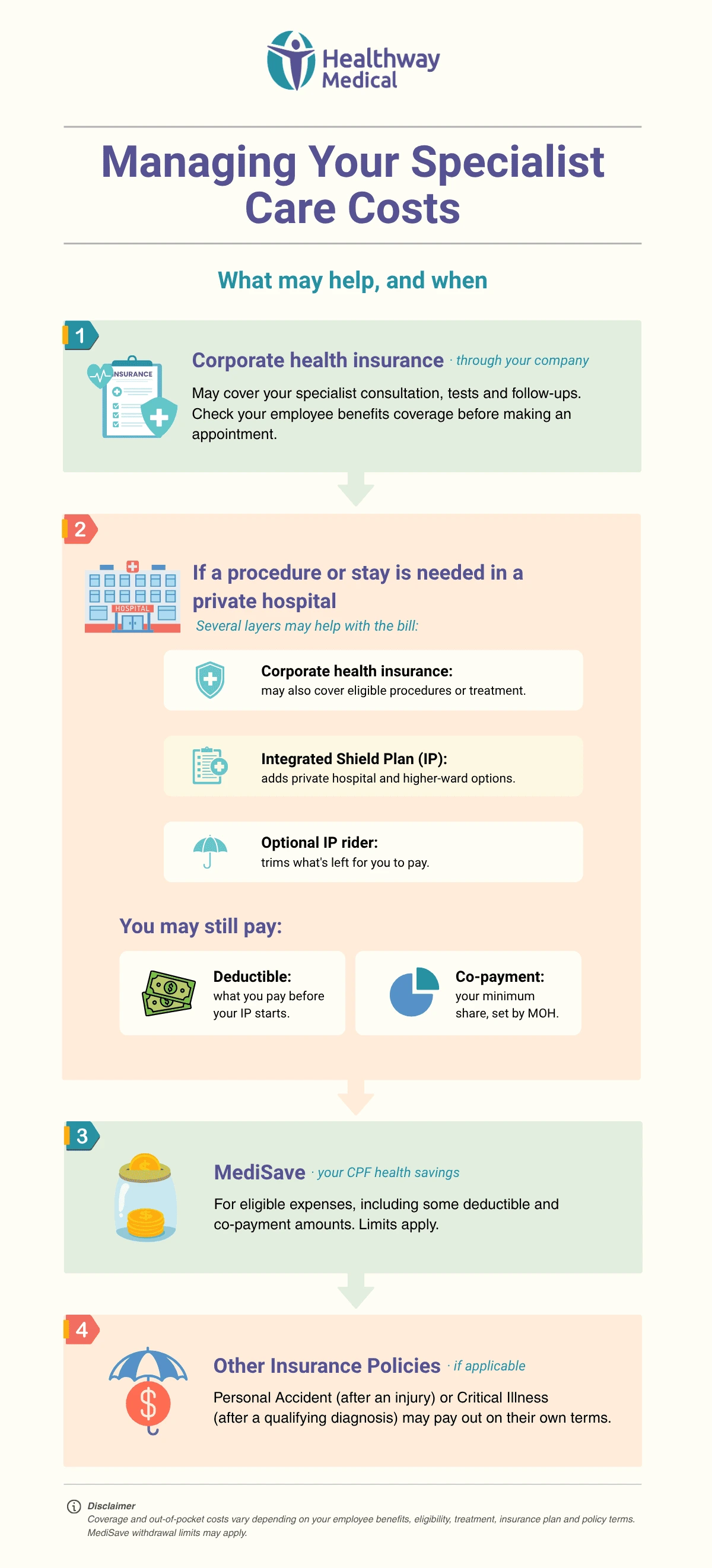
Corporate benefits may help with the first consultation and, under some plans, the treatment that follows. For an eligible procedure or treatment in hospital, MediShield Life, an Integrated Shield Plan and MediSave may also come into play. Other personal policies may also help when care follows an accident or qualifying diagnosis, involves a hospital stay, or affects your income.
The visual guide below shows what to check first and how these options may fit as your care progresses.
Start with Your Corporate Health Insurance

If you receive medical benefits through work, this is the first place to look for help with the outpatient consultation costs. What is covered, and how you access those benefits, depends on the plan your employer has arranged.
What Your Corporate Health Insurance May Cover?
Your corporate medical benefits may include:
- Specialist consultations and follow-up visits
- Diagnostic tests ordered as part of the visit, such as blood tests or scans
- Specialist care for your spouse or children, if dependant coverage is included
Once you know what is included, the next step is to understand how your plan wants the appointment to be arranged.
What Should You Confirm Before Booking a Specialist Consultation?
Start with your benefits portal. If the details are unclear, your HR team, insurer or third-party administrator (TPA) can help. A TPA is a company appointed to manage parts of the medical plan, such as provider panels, approvals, billing and claims.
Questions to ask before making an appointment:
- Is the specialist consultation covered?
- Do I need a GP referral?
- Must I see a panel specialist?
- Is approval required before the appointment?
- Are there per-visit or annual limits?
- Is direct billing available, or must I pay first and submit a claim?
- What documents should I bring?
It is worth checking the referral and panel requirements early. A panel specialist is a doctor within the approved network for your corporate health insurance plan. Depending on your corporate medical coverage, you may need a GP referral, see a panel specialist, or meet both requirements for the consultation to be covered.
At Nobel, each specialist's profile shows the TPA and insurance panels on which they are listed.
Can Direct Billing Lower Your Upfront Payment?
If your corporate health insurance plan offers direct billing at the clinic, eligible charges are sent directly to your insurer or TPA. Instead of settling the full bill and claiming it back later, you may only need to pay for charges outside your benefits or above your plan limits.
Quick takeaway: Your company’s employee benefits or corporate insurance plan may help with outpatient specialist consultation and treatment costs. It may also have components that can help manage the costs of inpatient treatment. Check what it covers at both stages.
If Your Specialist Recommends Day Surgery or Inpatient Treatment

Your corporate benefits may continue beyond the consultation. Some plans cover eligible procedures, day surgery or inpatient treatment in hospital, so begin by checking what yours includes.
Then review your Integrated Shield Plan (IP) and rider. More than one plan may apply to the same bill, and the amount each pays depends on its terms. Ask your HR team, TPA provider, and insurer how the claim will be handled and the out-of-pocket costs you may need to pay. The specialist clinic will be able to help you with the process too.
Understanding MediShield Life, Your IP and Rider
MediShield Life is the national health insurance scheme for Singapore Citizens and Permanent Residents. It helps with large hospital bills and selected outpatient treatments but is designed around subsidised care in public hospitals.
An Integrated Shield Plan (IP) combines MediShield Life with additional private insurance coverage. Depending on your plan, it may provide coverage for care in private hospitals, higher ward classes in public hospitals and eligible care pre- and post-hospitalisation.
If your procedure or hospital treatment is claimable under your IP, you generally do not need to make a separate MediShield Life claim. Your IP insurer will process both the MediShield Life and private insurance portions for you.
An IP rider is an optional add-on that may reduce the amount you need to pay towards an eligible bill. The benefits may depend on conditions such as seeing a panel specialist or getting pre-authorisation for your estimated bill.
Even when treatment is covered, you will usually remain responsible for two parts of the bill:
- The deductible is the amount you pay before your IP starts paying. The minimum IP deductible set by MOH ranges from S$1,500 to S$3,500 per policy year, depending on the ward class.
- The co-payment is your share of the remaining eligible bill. IP riders are still required to have a co-payment of at least 5%.
The deductible and co-payment may be paid using MediSave, subject to the prevailing withdrawal limits, or in cash.
Under the new IP rider requirements introduced on 1 April 2026, new riders can no longer cover the minimum IP deductible. The minimum annual co-payment cap has also increased to S$6,000, excluding the deductible. Read our guide to the Integrated Shield Plan rider changes to learn more.
Can MediSave Be Used for Specialist Care?
MediSave generally cannot be used for a routine outpatient specialist consultation on its own. However, it may help if your specialist recommends an eligible scan, outpatient treatment, day surgery or hospital procedure.
MediSave is your CPF healthcare savings, not insurance. Within the prevailing withdrawal limits, it may be used for:
- Eligible hospital and surgical charges
- Approved day surgery
- Selected scans and outpatient treatments
- The deductible and co-payment for an eligible hospital or treatment bill
You may also be able to use an eligible family member’s MediSave, depending on the treatment and applicable requirements.
CPF sets out the details for outpatient treatments and hospitalisation and day surgery.
What Should You Confirm Before Your Procedure?
Before scheduling your procedure, check the following with your HR team, corporate insurer or TPA, and IP insurer where applicable:
- Your coverage: Is the treatment covered under your corporate health insurance, IP or rider? Are related consultations, scans and follow-ups included?
- Your specialist and hospital: Is the specialist on your insurer’s panel, and is the hospital covered under your plan?
- Approval and admission: Do you need pre-authorisation, and can your insurer issue a Letter of Guarantee to help with the hospital deposit?
- What you will pay: What deductible and co-payment will apply, and can MediSave be used towards the eligible amount?
Confirming these details before treatment gives you a clearer view of which benefits may apply and your out-of-pocket costs.
Can Other Insurance Policies Help with Specialist Costs?
Beyond your medical coverage, you may have other policies that provide financial support in specific situations. Depending on why you need specialist care, these policies may reimburse certain expenses or provide a cash payout that helps with out-of-pocket costs and time away from work.
Personal Accident Cover for Injury-Related Care
If an accident leads to a specialist consultation or treatment, your Personal Accident policy may reimburse eligible medical expenses or provide a fixed benefit. What you can claim may depend on the nature of the accident, when you receive treatment and your policy limits. Contact your insurer as soon as practical to confirm what is covered and what documents you will need.
Critical Illness Support Beyond Medical Bills
Critical Illness insurance generally provides a lump-sum payout when you are diagnosed with a condition that meets your policy’s definition. Unlike medical insurance, the payout is not based on the cost of each consultation or treatment. It is paid directly to you and may help with medical costs, time away from work or other everyday expenses. The specialist visit itself does not trigger a claim; the diagnosis must meet your policy’s conditions.
Hospital Cash Cover for Added Expenses
Hospital cash insurance pays a fixed amount for each day you spend in hospital, rather than reimbursing the treatment bill itself. The payout may help with expenses such as transport, caregiving or lost income while you recover. The daily benefit, qualifying hospital stay and number of covered days vary by policy, so check your terms before relying on it.
Disability Income Cover if Treatment Keeps You from Working
If an illness or injury prevents you from working for an extended period, Disability Income insurance may replace part of your income, depending on your policy. It does not pay the specialist or hospital bill directly, but it may help with everyday expenses while you recover.
Before You Book, Know Where to Look

You often have more than one source of cover to draw on. A good approach is to start with what is available to you and work through your coverage in order. For many working adults, that means checking corporate medical benefits.
- For the first consultation: If you have corporate benefits, check whether they cover the visit and require a GP referral or panel specialist. If not, ask the clinic what fees to expect before booking.
- If further treatment is recommended: Check whether any corporate hospital or surgical benefits apply, then review your IP and rider. Ask about panel requirements, pre-authorisation and what you may still need to pay.
- For the remaining costs: Find out whether MediSave can be used for eligible charges. If your circumstances fit, other personal policies may provide separate financial support.
You do not have to make sense of this alone. Your HR team or TPA representative can explain your corporate benefits, your insurer can clarify your coverage, and the specialist clinic can help with its billing arrangements. Speaking to them before you proceed can give you a clearer idea of what is covered and what you may need to pay.
Many Nobel specialists are accredited on TPA and insurance panels. Where direct billing is available, it can reduce your out-of-pocket costs.
Ready to speak to a specialist?
Frequently Asked Questions
How Can I Estimate the Cost of Seeing a Specialist in Singapore?
Consultation fees vary by specialty, doctor and clinic, while tests, scans and procedures may be charged separately. Ask the clinic for an estimate, then check whether your corporate benefits cover the visit, require a referral or panel specialist, or offer direct billing. This will give you a more useful idea of what you may need to pay.
Can Corporate Health Insurance Cover Outpatient Specialist Care?
Depending on your plan, corporate health insurance may cover specialist consultations, follow-up visits and certain diagnostic tests. Your benefits may include limits or require a GP referral, panel specialist or prior approval, so check your benefits portal or ask your HR team, insurer or TPA representative before booking.
Do I Need a GP Referral to See a Private Specialist?
You can usually book a private specialist directly. However, your corporate medical plan may require a GP referral before it will cover the consultation.
A GP can also assess your concern and guide you to the appropriate specialty. You can find a Healthway Medical GP clinic if you need advice or a referral.
Which Insurance Panels Do Nobel Specialists Participate In?
Nobel specialists participate in panels and healthcare networks managed by major insurers and Third-Party Administrators, including AIA, Great Eastern, HSBC, Income, Prudential, Singlife, Fullerton Health, IHP and MHC. Panel participation varies by specialist. A panel listing does not automatically mean that every consultation or treatment will be covered. Confirm the specialist’s current panel status, your benefits and any referral or pre-authorisation requirements with your insurer before booking.
Does MediShield Life Cover Outpatient Specialist Visits?
MediShield Life generally does not cover a routine outpatient specialist consultation. It is designed for large hospital bills, day surgery and selected costly outpatient treatments. See the current MediShield Life benefits for details.
Can an Integrated Shield Plan Cover Private Specialist Treatment?
An IP may cover eligible specialist treatment connected to hospitalisation, day surgery or approved pre- and post-hospitalisation care. It does not mean that every specialist consultation or procedure is covered. Check your panel, hospital and pre-authorisation requirements, as well as the deductible and co-payment you may need to pay.
Can Other Insurance Help with Specialist Costs?
Depending on the circumstances, Personal Accident insurance may cover eligible injury-related expenses, while Critical Illness insurance may provide a payout after a qualifying diagnosis. Hospital cash and Disability Income policies may also help with expenses or lost income, according to their terms.
This article provides general information. Coverage, panel participation, direct billing and out-of-pocket costs vary by plan, specialist, treatment and policy terms. Confirm your benefits with the relevant insurer before booking.